Wednesday, February 16, 2011

Wednesday Reads: Girl in the Arena

Girl in the Arena by Lise Haines was one of those "so close but no cigar" novels... well, maybe half a cigar. It's also one of those extremely subjective things. One of you might have loved it, one of you might have hated it. Me... I'm on the fence of liked, as you'll see below.

Synopsis:

During the week, Lyn lives in a big house in Cambridge, and hangs out with friends in Harvard Square. But over the weekends she cheers her father on when he gears up for neo-gladiator competition—a high-profile televised blood sport that rivals the NFL. Lyn’s father is the top player in the league, and the paparazzi that have always swarmed him have started to dog Lyn’s every move. All this fame comes with an even higher price. Lyn’s family lives with the constant presence of violence, uncertainty, and a strict cultural code set by the Gladiator Sports Association. When a skilled young fighter slays Lyn’s father, the GSA imposes an unthinkable sentence—Lyn must marry her father’s murderer. Though her mother has made a career out of marrying into Glad culture, Lyn is prepared to do whatever it takes to claim her independence. Even if it means going into the arena herself….  Lise Haines’s debut novel, a dark satire for our time, is a mesmerizing look at a modern world addicted to violence, fame, and greed—a world eerily close to our own.

First Sentence: I'm skipping the prologue because it's the history of the Gladiator sport and, while informative and helps set up the entire novel, isn't thrilling. In the first chapter: "The clerk asks for my autograph." Also, not thrilling. But it sets up the fact that Lyn is somewhat famous.

Beefs: That "no cigar" thing comes mostly from the execution of the novel. The plot and characterizations are fantastic, flawless almost. But the writing style was very... forgettable. Which, combined with the almost flawless plot and characterizations, is a complete contradiction. Mostly what bugged me about the writing was that dialogue was presented with dashes when someone spoke, rather than the usual quotation marks. It bugged my mind so much I almost stopped reading. Probably the other thing that bugged me was the fact that this novel is defined as "dark satire." I'm good with the dark part (I like the plot, remember?) but the satire part I have half an issue with. Call it the ending, follow through, lack of action, I'm not sure but something was off.
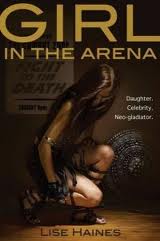
Brownie Points: The world. At times you think you've been transported to a futuristic dystopian society, but Haines is very good at sneaking in references to things we are very familiar with today, so we remember we are in today. She references movies, books, technology (though some of their technology is above and beyond our own), second lives, etc. Brownie Point 2, as I said above, the plot. I love the idea. A sort of Gladiator meets Hunger Games. Brownie Point 3, the cover. Beautiful. If I'd seen it on the shelf (found it on Amazon I think), I would have snagged it right up.

Ending: Not satisfying. Great build up, but once you get to the end scene, it sort of ends. I think this has something to do with the "satire" part of the genre, like there was a point to be made. But I think the point would have been better made if she'd driven the ending with more force (more Hunger Games, or even Gladiator).

Recommendation: I'd love the opinion of someone who likes satire. Perhaps this is one of those Fight Club things (which she references). I have complete respect for Chuck Palahnuik, but the guy is a little to much for my brain to handle (perhaps this is contradictory as well, considering my more morbid tastes in books and movies).

Would I represent it? I'd definitely go for something with a plot and world like this. The characters are great as well. But I would have rejected this if I found it in my slush pile, or tried to convince the author to change it.

Monday, February 14, 2011

Rejection Rate: Take 3

It's that time of month again: lucky 13th has come and gone (today's the 14th, you very smart readers, I know, but better late than never). And here are my rejection stats and advice for the month.

This month has been a little more productive than last month. While I didn't request many more partials based on the query alone (okay, actually I requested 1% more this month than last month), I did request more partials based on the first 20 or 50 pages. I read 3 full manuscripts (2 more than last month), but signed only one client.

So, of approximately 600 queries since December, I've signed one author. To put that into perspective, you have a 29% chance of getting pages requested based on your query. A 12% chance of getting more pages requested based on the initial sample. And a .167% chance of being signed.

Things that will significantly increase your chances? Based mostly on bios of people I request and reject, those who have worked with editors, participate in critique groups, and attend conferences, are much more likely to have more pages requested. Why is this? Because they've worked on their craft longer. If not longer, than they have been using the right tools.

Put it this way: two people are building a house. One man is building it based on the other houses on the street, from what's he's observed. The other man took classes, bought the right tools. Which house is going to be sturdier? Last longer? Be more visually pleasing? The man who took classes, right? Of course, there are exceptions to every rule. There might be one man in a million that can build that house with no prior experience and you can't tell the difference between him and the professional. For your sake however, don't consider yourself the exception. More often than not, you are the rule.


This month, I've noticed a change in how I read things. Maybe I'm becoming a "real agent"? Haha, let's hope so. Last month, I think I was looking at a good five pages of a partial before giving it the boot. Giving it a real chance. I don't have the time anymore. More often than not, I don't get past two paragraphs. Sometimes, I actually stop at the first line. When people tell you how important that first line is, they aren't joking. First line, first five pages, first fifty, first one hundred, the whole book. Open your ms, what's happened in the first page? What's happened by the first fifty?

That's my advice this month. It's short, it's bitter-sweet, but maybe it will help. Have a writer/editor friend read your manuscript and give you constructive criticism (or pay for it; this route is invaluable if you find a good editor because they are an unbiased party). Examine your ms at specific points- first sentence, first paragraph, first page, first five pages, first twenty, first fifty. What's happening at each of these points? If nothing has happened by page five, you might have too much back story. You might be starting in the wrong place. If nothing has happened by page fifty (has the main character's life been altered by this point?) then the beginning is too slow.

Happy writing!

Thursday, February 10, 2011

Common Spelling Errors and Other Rants

Just a few things that make me chuckle (and/or tear my hair out). You'll find the same advice pretty much anywhere, but in case you missed it, you get it here too.

Bizarre and Bazaar are two different words.  I've actually seen this misused several times in manuscripts.  I don't judge.  I laugh, but I don't judge.

Their, there, they're... enough said.  You're a writer.  Get it right.

"It's" means "it is." "Its" is possessive. That's all I'm saying.

The dreaded double space... I'm a little behind the times. Recently I mentioned on Twitter that I heard you are no longer allowed to double space between sentences. Look, I'm doing it--it looks weird. Aside from the cramped-togetherness, I'm bewildered I hadn't heard of this until now. Several people responded to my tweet and said EVERYONE is demanding this change, agents, editors, EVERYONE. Since I want to be part of this community, I'll give it a try. It's hard. Each time I press the space bar after a period I want to do it twice. Each time. Ack. Ack. Ack.

"I love this Alot" You'll never misuse "a lot" again. And if you twitch every time someone else uses "alot," you can think of this and smile.

The semicolon. I take it as a personal insult if someone misuses the semicolon. I've always been a semicolon lover; it's my favorite form of punctuation. If you don't know how to use them, don't use them. If you're clear on the rules, then have fun. But, again, use them sparingly (and don't read Herman Melville, the man is a semicolon fanatic, and your own writing will be swayed by his influence--believe me, I learned the hard way). Two rules for the semicolon: 1 use it to separate two complete sentences of a connected thought without a coordinating conjunction (and, but, or), or with a transitional phrase (of course, however); 2 use it to separate items in a complicated list (ie dates, or in which you use commas within the items).
Surprisingly, Wikipedia has a pretty good entry on semicolons right here.  (Hope you noticed I used the semicolon twice in that paragraph, and I used them correctly.)

Since I'm on a roll, I might as well mention two things people always look for. Easy ways to tell a great manuscript from an ok manuscript.

Adverbs. Stay away. They clutter sentences and don't convey as much as you might think. The reader should be able to tell what's going on in the scene without the adverbs. If you absolutely need the adverb, see if you can rewrite it without it (show don't tell). A few adverbs is fine, but I don't want to see ten on a page. Adverbs are much more powerful if you use them sparingly.

Dialogue tags. I'm guilty of it too. I used to think dialogue tags were awesome! Use as many as possible and never use the same one twice. WRONG. Use different dialogue tags sparingly. If you only have one "he/she said" in every dozen (or heck, even every other one), you're using too many dialogue tags. Stick with "said" and "asked." Replace all of your dialogue tags, go back and read it. If the reader can't tell what emotions the character is portraying without your fancy tags, you need to rewrite the scene (show don't tell). As with adverbs, dialogue tags are going to be much more powerful if you use them sparingly.

Happy writing!

Wednesday, February 9, 2011

Wednesday Reads: Spellbent

Spellbent by Lucy A Snyder isn't a waste of time.  Oh, and apparently it's a debut, so props to Snyder.  It's Paranormal Romance in the sense that love is what drives the plot forward, the only reason main character Jessie Shimmer is defying the government's order to leave her boyfriend where he is (in hell) and stop meddling.  You meet Cooper in the first chapter, and see him again at the end, but otherwise, other than Jessie reflecting again and again about her unconditional love, we see no romance.  This is Paranormal beats Romance for Romance sake.

Synopsis: (From Amazon)
Snyder’s debut is the first in a new urban-fantasy series starring twentysomething Jessie, an apprentice witch, and her wizard tutor and lover, Cooper. Both Jessie and Cooper have animal-shaped familiars (demons in disguise) to assist with their magic. All hell breaks loose when Jessie and Cooper start a rain spell in the city park, and a reality-shifting portal arrives along with the storm. Jessie barely survives the mayhem and soon finds herself on the outs with the local magic community after she insists on hunting down and rescuing Cooper. This fast-paced urban fantasy has a few twists that make it stand out from the pack. Yes, the plot moves quickly, but that doesn’t stop Snyder from developing her characters and building her world. Fans of Kim Harrison’s Rachel Morgan series should be pleased with Jessie, another butt-kicking female witch who doesn’t let anyone tell her what to do.
 First Sentence: From the prologue: "My name is Jessie, and I'm the reason why your life is about to change forever."  I have no idea who she is addressing, and why my life is going to change.  Apparently, you need to read the next book in the series (or perhaps the next one, or the one after that?) to find out.  Honestly, I could have done without the prologue.  It tells me nothing.

From the first chapter: "Cooper woke me up before the nightmare did."  It gives you plenty of information while leaving enough questions to be answered in the following sentences.  What bugs me about this opening though is the ambiguity.  Is it her nightmare or Cooper's that would have woken her?  It wasn't clarified until many sentences later.

Beefs: Cooper, probably from the fact that he is absent pretty much the entire book, is under developed.  Due to an evil character in the book, I actually started to wonder if Cooper was a bad guy too, playing Jessie.  This would have been a great device, start doubting Jessie's decisions, however, it isn't entirely clear whether this was intentional by the author or not.  Cooper started bugging me, a lot, and I started to hate him (and in turn, Jessie, because she wasn't figuring anything out fast enough for me to decide whether or not to like him), and it isn't until EVERYTHING is revealed that I got sympathy for Cooper--but then I had only sympathy for him; I forgot about why Jessie loved him in the first place, and saw him as a weakling Jessie needed to save.

Brownie Points: Despite my rant above, it was a good book, good plot, and mostly good (fast) pacing.  Once Jessie made up her mind to kick butt, she let nothing stop her.  I loved her familiar, ferret Pal, who waxed and waned between stuck up and helpful and funny.  Dogs and cats are so overrated as familiars, I was happy to see Snyder taking a new approach, even if Pal wasn't.

Ending: Except for the epilogue, which did nothing but remind us that Snyder (Jessie) has a terrific, funny voice, the ending closed enough doors to leave us satisfied, while keeping one or two open for a sequel.

Recommendation: If you like sassy female leads with a good voice, a twist on Paranormal (no vampires here, I promise), a whirlwind ride you literally don't know how it's going to end, less romance than paranormal, and a smile/horrific look on your face the entire way through, then I'd definitely recommend this.

Would I represent it? Very possibly.  Like I said above, there were many things I found wrong with it.  While I like more paranormal than romance in my Paranormal Romances, this left me wanting.  However, I'd definitely go for something very similar (but not too similar or you stop being original, duh).

Happy Reading!

Wednesday, February 2, 2011

Wednesday Reads: Cancer is a Funny Thing

A little different than my usual review. Marie de Haan is a Northwest local and a member of Just Write, a writing group on Whidbey Island. Her memoir, Cancer is a Funny Thing: A Humorous Look at the Bright Side of Cancer... And There Is One, is just that: a humorous story about how she overcame cancer.

I'll say this right now before you start skimming: this is exactly the kind of book anyone with cancer, had cancer, knows someone with cancer, or wants a good read about overcoming odds, should read/buy/gift it.

Synopsis (from the back cover):
Marie de Haan--wife, mother of three, piano teacher, songwriter, and writer--was leading an impossibly busy life. All of that changed when she was blindsided by a diagnosis of Stage 3 breast cancer.

She got even busier.

From chemotherapy and surgery to battles with the insurance company, tussles with her naturopath over the consumption of sugar to internal debate over whether or not to endure radiation, Cancer is a Funny Thing details how Marie handled these issues: with humor and grace. And Haagen-Dazs chocolate-mint ice cream.

First Sentence: "As I sat on the piano bench, teaching little Anna how to run up and down the B major scale with her nimble fingers, I resisted the urge to grab my right boob and yell, "Ow, ow, ow!" at the top of my lungs." Now, is that a way to start a book or what? And her humor persists throughout the entire novel, just as the title promises.

Brownie Points: You don't need to have had cancer to appreciate this book. The humor makes it accessible to everyone.

Ending: Fantastic. A beautiful ending. Pretty much as you'd expect. Heart warming. Inspirational, without losing the humor of the book or getting too Lifetime.

Recommendation: As I said above, this is a book you should get for anyone you know with cancer, if you have cancer, etc, etc. My copy will be so well used and borrowed, I'll be surprised if it doesn't fall apart before long.

Would I represent it? Perhaps. It depends on platform. Marie has a good platform--not huge, but good-- but there is no telling if an editor would have scooped it up for the writing alone. Marie went the self publishing route because she wanted to see her book in print sooner rather than later. In things like this, I'm definitely looking for humor. I'm not a big crier, and tend to sway towards humor instead.

Happy reading!